Measure Functional Kinase Activity Directly in Cell Lysates
Move beyond phosphorylation snapshots.
PhosphoSens® Lysate Assays deliver real-time enzyme activity data in biologically relevant lysates. Unlike IP-based assays that strip enzymes from their regulatory environment, PhosphoSens retains signaling architecture while achieving enzyme-level resolution through substrate design — revealing how kinases truly behave where biology happens.
Stop inferring activity. Start measuring it.
The Limits of Phospho-Protein Measurements
Phosphorylation ≠ Activity
Phosphorylation status alone does not reliably report enzymatic function. Activation-site phospho-antibodies treat phosphorylation as a surrogate for activity, while downstream substrate phosphorylation reflects real signaling output but often makes it impossible to identify which kinase was responsible.
PhosphoSens Lysate Assays measure what matters most: functional kinase activity on a defined substrate.
Rather than infer activity from proxies, you directly quantify catalysis by your target kinase in its native cellular context.
-
Mechanistic specificity (you control the substrate)
-
Physiological relevance (you preserve cellular context)
PhosphoSens Lysate Assays: Built to Measure Kinase Activity in its True Biological Context
Preserve Cellular Context Without Losing Specificity
Western blot and phosphoproteomic methods preserve cellular context but conflate modification with enzymatic activity.
IP-based assays isolate kinases from their regulatory environment — removing cofactors, modulators, and feedback loops.
PhosphoSens Lysate Assays strike a critical balance:
You preserve cellular complexity while isolating catalytic activity through substrate specificity.
-
Native cofactors, scaffold proteins, phosphatases, and modulators to remain intact
-
Activity to be measured directly on a defined, relevant substrate
-
Regulation to be observed in real time, as it occurs biologically
|
Activity Measurement |
Quantitates target kinase activity specifically and directly |
|---|---|
|
Native Context |
Monitors activity in real time in native cell & tissue lysates |
|
Antibodies Required |
Works without antibodies or fractionation |
|
Biological Value |
Reveals biologically meaningful and actionable data on target kinase |
Trusted by Researchers
"Most studies of protein kinases in disease focus on changes in gene expression, but not activity, thereby missing critical information. AssayQuant’s protein kinase activity assays with kinase-selective sensor peptides are a game-changer. They serve as vital tools for profiling kinase activity in research and clinical samples to assess disease etiology, progression, and individual responses to drug treatment. The kinetic information from these kinase-selective sensor peptides enables studies in tissue and cell culture lysates with high confidence and relative ease, permitting synergy with genomic, transcriptomic, proteomic, and proteogenomic platforms by providing quantitative functional proteomics data for individual kinases, affording greater insight into disease states across biology and medicine."
What True Kinase Activity in a Biological Context Looks Like
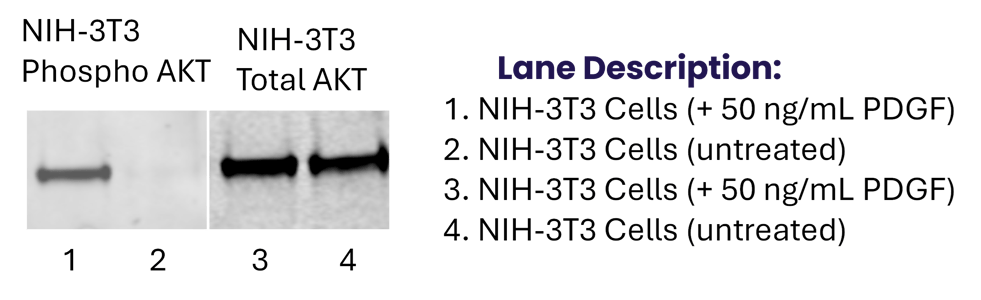
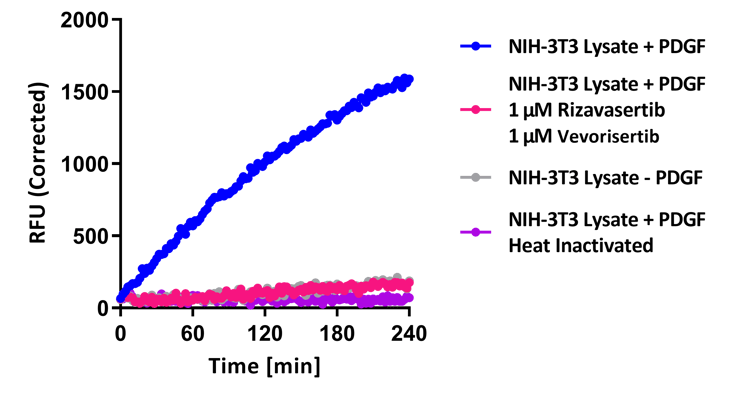
PDGF Stimulates AKT Activity Far Beyond What Phospho-Readouts Suggest
In NIH-3T3 cells stimulated with PDGF, phosphorylation at canonical AKT activation sites increased modestly by Western blot.
In contrast, PhosphoSens Lysate AKT1/2/3 assays revealed a dramatic increase in functional catalytic output, exposing regulatory dynamics invisible to phospho-based methods.
This demonstrates a critical limitation of phosphorylation as a proxy:
Signaling strength and enzymatic output can diverge substantially.
PhosphoSens resolves this by measuring what ultimately drives biology: substrate turnover.
Explore sample data that uncovers pathway-specific kinase dynamics across diverse cell models — critical insights that we enable.
Study Kinase Activity Where Biology Happens
Most kinase assays overlook biological complexity.
To address this challenge in protein kinase inhibitor (PKI) development, we designed a kinase activity assay that delivers mechanistic insight and biological relevance.
Download our poster to learn how we are developing Selective Sensor Peptides that directly quantify kinase activity in crude cell lysates and tissue homogenates.

x48(h)_v5_ES_Final.png)
How PhosphoSens Measures Kinase Activity in Real Biological Systems & Why it Matters
PhosphoSens Lysate Assays quantify functional enzyme activity in real time by monitoring the fluorescence signal that is generated as the target-selective substrate is phosphorylated.
Because assays are performed in native lysates, natural cofactors and feedback pathways remain intact, providing biologically meaningful results that reflect real signaling dynamics.
With a simple add-and-read workflow, each well becomes a live readout of enzyme function, showing activation, inhibition, and regulatory effects as they occur.
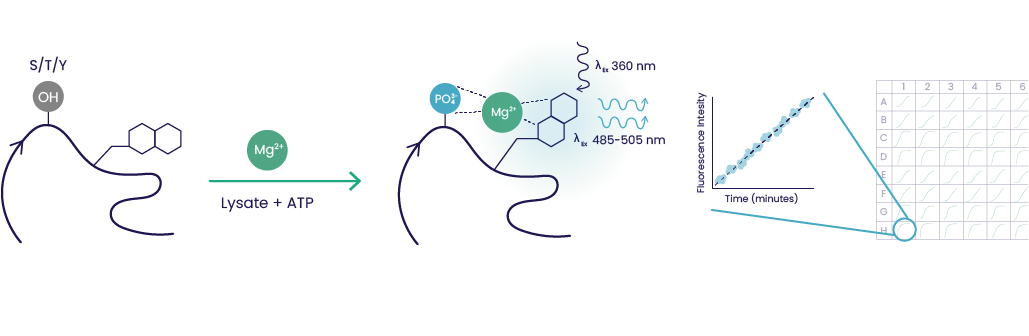
Unlike binding or phosphorylation-based approaches, activity is measured as enzymatic turnover — not inferred from modification or association.
Gain Mechanistic Insight
Measuring catalytic activity provides unambiguous evidence of whether a kinase is “on” or “off,” and by how much. This distinction is critical for mechanism of action (MoA) studies, where the difference between partial inhibition and full suppression can guide compound advancement.
Resolve Kinetic Behavior
Functional assays deliver progress curves and initial velocities, enabling researchers to distinguish reversible from irreversible inhibitors, capture time-dependent effects, and detect subtle shifts in enzyme regulation.
Maintain Biological Context
When performed in cell or tissue lysates, activity measurements incorporate cofactors, binding partners, and feedback regulation. This preserves the biological context that recombinant enzyme assays often lack.
Quantify with Confidence
Functional activity readouts offer fold-change measurements with wide dynamic range (e.g., 40–50× induction in stress-activated kinases such as JNK). This sensitivity allows confident go/no-go decisions in drug discovery.
Stop guessing at kinase function. Start quantifying it.
Discuss your targets or cell models with our team to see how PhosphoSens Lysate Assays can accelerate your discovery workflow.