Kinase selectivity profiling, compared: activity in real time vs. binding and endpoint panels
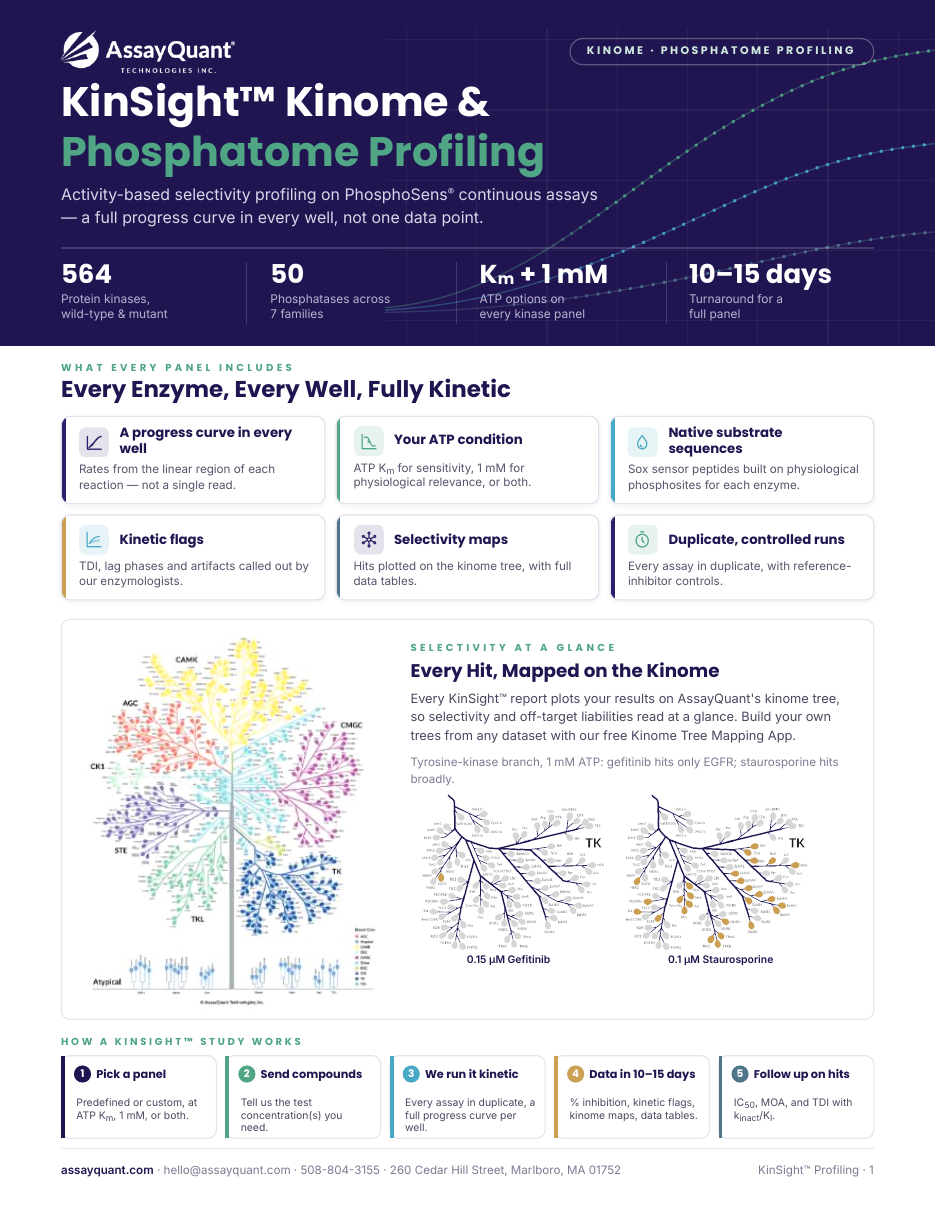
KinSight™ is activity-based selectivity profiling on our proprietary PhosphoSens® continuous assay platform: a full progress curve in every well, not one data point. Profile your compounds on 560+ kinases and 50 phosphatases at ATP Km and 1 mM ATP, and see how it compares with binding and single-read endpoint panels.
560+
Protein kinases, wild-type & mutant
50
Phosphatases across 7 families
Km + 1 mM
ATP options on every kinase panel
10–15 days
Turnaround for a full panel
Live webinar, Oct 29: Beyond Binding, with the scientist who runs our panels →
Download the KinSight™ profiling handout
The two-page KinSight™ profiling handout, as a PDF:
- Panel menu: 560+ kinases (163 mutants) and 50 phosphatases
- What every panel includes, at ATP Km and 1 mM
- The quartet: four kinases, same endpoint, four different mechanisms

Satish Pimrale
Satish helps discovery teams choose the right KinSight™ panel and follow-up kinetics, from a single target to the full kinome.
Scope your profiling panel
Tell us your targets and compound series. We will recommend the panel, ATP condition and follow-up studies.
How KinSight™ compares with other kinase profiling approaches
Most selectivity panels are built on binding or single-read endpoint assays. KinSight™ reads catalytic activity continuously, so every well delivers a progress curve, at physiological ATP, with phosphatases on the menu too.
| Profiling approach | Measures catalytic activity | Progress curve in every well | TDI flagged in the primary screen | 1 mM (physiological) ATP | Phosphatase panels |
|---|---|---|---|---|---|
| AssayQuant KinSight™Continuous fluorescence, PhosphoSens® sensor peptides | ✓Direct, real time | ✓Standard on every panel | ✓Curvature visible in the screen | ✓Every kinase panel, plus Km | ✓50 enzymes, 7 families |
| Competition binding panelsActive-site binding, reports Kd | ✕Binding only | ✕ | ✕ | ✕Run without ATP | ✕Not typically offered |
| Radiometric endpoint panels33P transfer, filter capture | ✓ | ~Single read; time course is a separate study | ✕ | ~Often a subset of targets | ~Limited |
| Luminescent ADP-detection panelsCoupled enzyme readout | ~Indirect, via coupled detection | ✕ | ✕ | ~Varies by assay | ✕Rarely offered |
| FRET / TR-FRET panelsAntibody or tracer readout | ~Indirect; some formats are binding | ✕ | ✕ | ~Often limited | ✕Rarely offered |
| Mobility-shift panelsSubstrate/product separation | ✓ | ✕ | ✕ | ~Some assays | ✕Rarely offered |
Typical capabilities of each assay format as offered by commercial profiling services; individual providers and panels vary. Ask us for a side-by-side on your target list.
Same endpoint. Four different stories.
Four kinases from one KinSight™ panel each showed 60–65% inhibition based on an endpoint read. Their continuous progress curves, with and without inhibitor, reveal four different mechanisms.
Clean, stable rates from 60+ timepoints per replicate: what a well-behaved reaction looks like (assumed, but often not the case).
Increasing scatter due to compound insolubility: something a single endpoint could never flag.
The curve flattens: covalent or slow off-rate. An early TDI flag for interesting MOA, followed up with kinact/KI.
A lag before steady state hints at conformational effects, e.g. an inhibitor preferring the inactive form.
Endpoint data estimates how much. Kinetics tell you precisely, and why.
See the full quartet data → · Panel details & target lists →
Every enzyme, every well, fully kinetic
A progress curve in every well
Rates from the linear region of each reaction, not a single read.
Your ATP condition
ATP Km for sensitivity, 1 mM for physiological relevance, or both.
Native substrate sequences
Sox sensor peptides built on physiological phosphosites for each enzyme.
Kinetic flags
TDI, lag phase and compound artifacts called out by our enzymologists.
Selectivity maps
Hits plotted on AssayQuant's kinome tree, with full data tables and histograms in the report.
Duplicate, controlled runs
Every assay in duplicate, with reference-inhibitor controls.
Predefined or custom, at ATP Km, 1 mM, or both.
Tell us your test concentration(s).
Every assay in duplicate, a full progress curve per well.
% inhibition, kinetic flags, kinome maps, data tables and recommendations.
IC50, MOA, and TDI (residence time or kinact/KI).
Kinase and phosphatase selectivity panels
Start from a predefined panel or design your own. Run any kinase panel at ATP Km, 1 mM, or both.
| Panel | Size | Use case |
|---|---|---|
| Wild-Type Protein Kinase Panel | 397 | Broad selectivity, safety tox, off-target ID |
| Complete Protein Kinase Panel | 564 | Comprehensive off-target screening |
| Tyrosine Kinase (TK) Panel | 83 | RTK / non-RTK selectivity profiling |
| Cyclin-Dependent Kinase (CDK) Panel | 32 | Cell cycle & oncology selectivity |
| Mutant Protein Kinase Panel | 163 | Resistance mutation profiling |
| KiNode Panel (representation from each kinome branch) | 71 | Focused selectivity screening |
| Kinase Safety (TOX) Panel | 16† | Early off-target safety liability screening |
| Custom Panel Design your own | 1–150 | Any program-specific target list |
| Phosphatase Panel | 50 | Ser/Thr, tyrosine & dual-specificity selectivity |
| Combined Full Kinome & Phosphatome Panel | 614 | Complete coverage to identify liabilities |
Kinase panels run on a biweekly schedule; alternative ATP concentrations on request. †TOX panel covers 16 of the 19 kinases recommended by the IQ DruSafe Secondary Pharmacology Working Group (Brennan et al., Nat Rev Drug Discov, 2024); the rest are in development.
Ser/Thr, tyrosine and dual-specificity phosphatases, each read with the PhosphoSens® sensor phosphopeptide substrate (13 peptides), including the SHP2 T253M/Q257L mutant.
Beyond Binding: Real-Time, Activity-Based Kinome and Phosphatome Profiling
Daniel Urul, PhD, the scientist who runs our KinSight™ panels, shows how continuous progress curves confirm each construct is behaving as expected, catch time-dependent and covalent inhibition, and take you from panel results to mechanism. Free, with live Q&A.
Kinase profiling questions, answered
What is the difference between binding-based and activity-based kinase profiling?
Binding panels measure whether a compound displaces a probe from the kinase active site and report dissociation constants (Kd), usually without ATP. They show binding, not whether catalysis is actually inhibited. Activity-based profiling such as KinSight™ measures phosphorylation itself in the presence of ATP, so it captures ATP-competitive, allosteric and substrate-competitive inhibitors in a functional context.
Can endpoint kinase assays detect time-dependent or covalent inhibition?
Only indirectly. For covalent and other time-dependent inhibitors, an endpoint IC50 shifts with pre-incubation and reaction time, so the right parameters are kinact and KI, which require progress-curve data (Strelow, SLAS Discovery 2017). PhosphoSens® reads every well continuously, so the curvature that signals time-dependent inhibition is visible in the primary KinSight™ screen.
Why profile kinase inhibitors at 1 mM ATP?
Cellular ATP is in the low-millimolar range, so ATP-competitive inhibitors that look potent at ATP Km can lose much of their activity in cells. Profiling at 1 mM ATP gives a more physiologically relevant selectivity picture. Every KinSight™ kinase panel can be run at ATP Km, 1 mM, or both; many profiling services offer 1 mM ATP for only part of their panel.
Does AssayQuant offer phosphatase selectivity profiling?
Yes. The KinSight™ phosphatase panel covers 50 phosphatases across 7 families (Ser/Thr, tyrosine and dual-specificity, including the SHP2 T253M/Q257L mutant), each read continuously with the PhosphoSens® sensor phosphopeptide substrate (13 peptides). It can also be combined with the full kinase panel in a 614-enzyme kinome and phosphatome panel. Phosphatase panels are rarely available from kinase profiling providers.
How many kinases are on the KinSight panels and how long does profiling take?
The Complete Protein Kinase Panel covers 564 kinases, including 163 clinically relevant mutants. Predefined panels include wild-type (397), tyrosine kinase (83), CDK (32), mutant (163), KiNode (71) and a kinase safety (TOX) panel, plus the 50-phosphatase panel and the combined 614-enzyme kinome and phosphatome panel. Custom panels of 1–150 kinases are available. Panels run on a biweekly schedule with a 10–15 day turnaround, in duplicate.
What does a KinSight report include?
Percent inhibition at each ATP condition, the full progress curve for every well, kinome tree maps, ranked waterfall plots, histograms and data tables, plus scientist-flagged time-dependent inhibition, lag phases and assay artifacts such as compound insolubility. Every assay runs in duplicate with reference-inhibitor controls. Hits can be followed up with IC50, MOA and TDI studies (residence time or kinact/KI).
How should I choose a kinase selectivity profiling service?
Match the assay to the question. Binding panels are useful for broad target engagement; activity panels show functional inhibition. If your series may be covalent or slow-binding, choose a continuous (kinetic) readout so time dependence is visible. Check whether physiological 1 mM ATP is available across the panels you need, whether mutants and phosphatases are covered, and what the report includes beyond a single % inhibition value.
Reference: Strelow JM. A perspective on the kinetics of covalent and irreversible inhibition. SLAS Discov. 2017;22(1):3–20.